Natural Language Processing vs. Machine Learning vs. Deep Learning
What is Natural Language Processing?
Natural Language Processing (or NLP) is an area that is a confluence of Artificial Intelligence and Linguistics. It involves intelligent analysis of written language. If you have a lot of data written in plain text and you want to automatically get some insights from it, you need to use NLP techniques. These insights could be sentiment analysis, information extraction, information retrieval, search etc. to name a few.
Machine Learning
Machine Learning (or ML) is an area of Artificial Intelligence (AI) that is a set of statistical techniques for problem solving. These techniques can be applied to a wide variety of problems which are not limited to vision based research, fraud detection, price prediction, and even NLP. In order to apply ML techniques to NLP problems, we need to usually convert the unstructured text into a structured dataformat.
Deep Learning
Deep Learning (which includes Recurrent Neural Networks, Convolution Neural Networks and others) is a type of Machine Learning approach. It is an extension of Neural Networks. Deep Learning is used quite extensively for vision based classification (e.g. distinguishing images of airplanes from images of dogs). Deep Learning can be used for NLP tasks as well. However it is important to note that Deep Learning algorithms do not exclusively deal with text.
Relationship between NLP, ML and Deep Learning
The image below shows graphically how NLP is related to ML and Deep Learning. Deep Learning is one of the techniques in the area of Machine Learning. There are several other techniques such as Regression, K-Means, and so on.
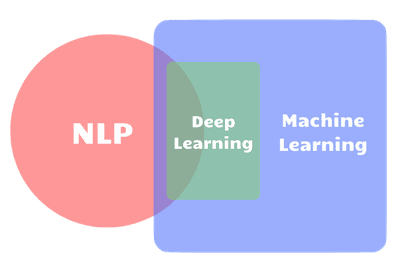
ML and NLP have some overlap, as Machine Learning is often used for NLP tasks. LDA (Latent Dirichlet Allocation which is a Topic Modeling Algorithm) is one such example of unsupervised machine learning.
However, NLP has a strong linguistics component (not represented in the image), that requires an understanding of how we use language. The art of understanding language involves understanding humor, sarcasm, subconscious bias in text, etc. Once we can understand what it means to be sarcastic (yeah right!) we can encode it into a machine learning algorithm to automatically and statistically discover similar patterns for us.
To summarize, in order to do any NLP, you need to understand language. Language is different for different genres (research papers, blogs, and Twitter have different writing styles), so there is a strong component of looking at your data manually to get a feel of what it is trying to say to you, and how you- as a human would analyze it. Once you figure out what you are doing as a human reasoning system (ignoring hashtags, using smiley faces to imply sentiment), you can use a relevant ML approach to automate that process and scale it.