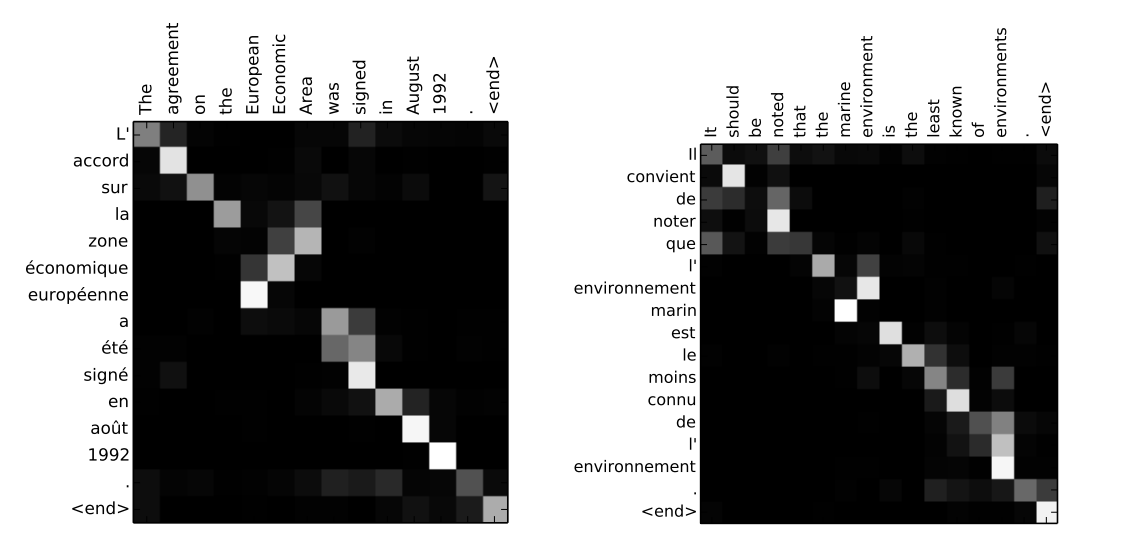
Attention mechanisms revolutionized machine learning in applications ranging from NLP through computer vision to reinforcement learning. Attention is the key innovation behind the recent success of Transformer-based language models such as BERT.1 In this blog post, I will look at a first instance of attention that sparked the revolution: additive attention (also known as Bahdanau attention) proposed by Bahdanau et al.2
The idea of attention is quite simple: it boils down to weighted averaging. Let us consider machine translation as an example. When generating a translation of a source text, we first pass the source text through an encoder (an LSTM or an equivalent model) to obtain a sequence of encoder hidden states  . Then, at each step of generating a translation (decoding), we selectively attend to these encoder hidden states, that is, we construct a context vector
  that is a weighted average of encoder hidden states:
![\[\mathbf{c}_i = \sum\limits_j a_{ij}\mathbf{s}_j\]](/assets/b4ebd58246-69f9124ba310cbe04358c08d_69f91227c639525e78a50e49_quicklatex.svg)
We choose the weights  based both on encoder hidden states and decoder hidden states
  and normalize them so that they encode a categorical probability distribution
  .
.
![\[\mathbf{a}_i = \text{softmax}(f_{att}(\mathbf{h}_i, \mathbf{s}_j))\]](/assets/b30862af1d-69f9124ba310cbe04358c0ba_69f9123611886df9ca7caaea_quicklatex.svg)
Intuitively, this corresponds to assigning each word of a source sentence (encoded as  ) a weight that tells how much the word encoded by is relevant for generating subsequent
  th word (based on
  ) of a translation. The weighting function
  (also known as alignment function or score function) is responsible for this credit assignment.
There are many possible implementations of  , including multiplicative (Luong) attention or key-value attention. In this blog post, I focus on the historically first and arguably the simplest one: additive attention.
Additive attention uses a single-layer feedforward neural network with hyperbolic tangent nonlinearity to compute the weights :
![\[f_{att}(\mathbf{h}_i, \mathbf{s}_j) = \mathbf{v}_a{}^\top \text{tanh}(\mathbf{W}_1 \mathbf{h}_i + \mathbf{W}_2 \mathbf{s}_j)\]](/assets/9f8ed755ab-69f9124ba310cbe04358c0ab_69f9123dff60b9894cbe9ec3_quicklatex.svg)
where  and
and  are matrices corresponding to the linear layer and
  is a scaling factor.
PyTorch Implementation of Additive Attention
class AdditiveAttention(torch.nn.Module):
    def __init__(self, encoder_dim=100, decoder_dim=50):
        super().__init__()

        self.encoder_dim = encoder_dim
        self.decoder_dim = decoder_dim
        self.v = torch.nn.Parameter(torch.rand(self.decoder_dim))
        self.W_1 = torch.nn.Linear(self.decoder_dim, self.decoder_dim)
        self.W_2 = torch.nn.Linear(self.encoder_dim, self.decoder_dim)

    def forward(self,
      query, # [decoder_dim]
      values # [seq_length, encoder_dim]
    ):
        weights = self._get_weights(query, values) # [seq_length]
        weights = torch.nn.functional.softmax(weights, dim=0)
        return weights @ values # [encoder_dim]

    def _get_weights(self,
      query, # [decoder_dim]
      values # [seq_length, encoder_dim]
    ):
        query = query.repeat(values.size(0), 1) # [seq_length, decoder_dim]
        weights = self.W_1(query) + self.W_2(values) # [seq_length, decoder_dim]
        return torch.tanh(weights) @ self.v # [seq_length]
Here _get_weights corresponds to , query is a decoder hidden state and values is a matrix of encoder hidden states  . To keep the illustration clean, I ignore the batch dimension.
In practice, the attention mechanism handles queries at each time step of text generation.
Here context_vector corresponds to . h and c are LSTM’s hidden states, not crucial for our present purposes.
Finally, it is now trivial to access the attention weights and plot a nice heatmap.
attention = AdditiveAttention(encoder_dim=100, decoder_dim=50)
encoder_hidden_states = torch.rand(10, 100)
decoder_hidden_states = torch.rand(13, 50)
weights = torch.FloatTensor(13, 10)
for step in range(decoder_hidden_states.size(0)):
    context_vector = attention(decoder_hidden_states[step], encoder_hidden_states)
    weights[step] = attention._get_weights(decoder_hidden_states[step], encoder_hidden_states)
seaborn.heatmap(weights.detach().numpy())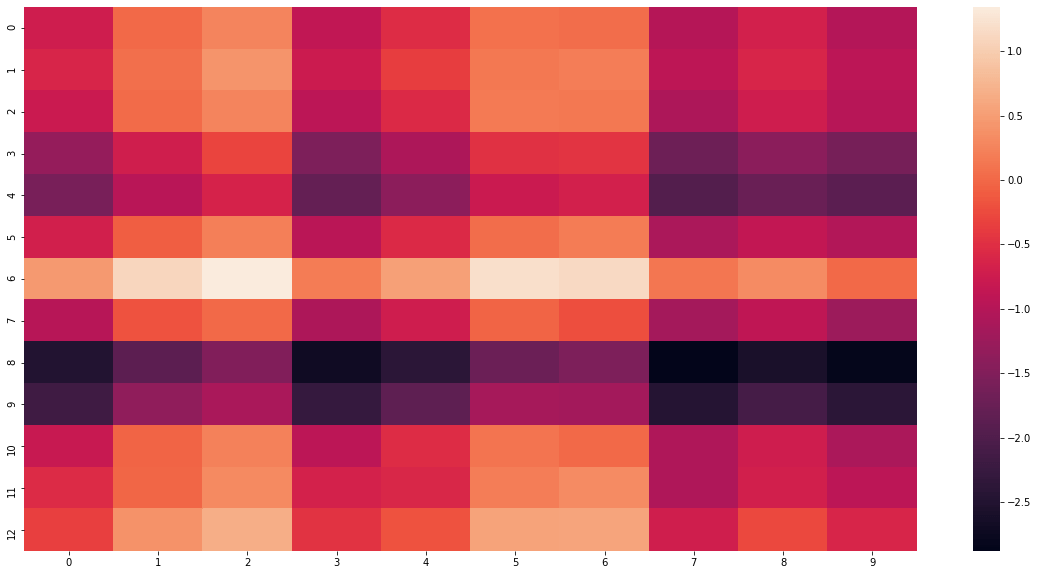
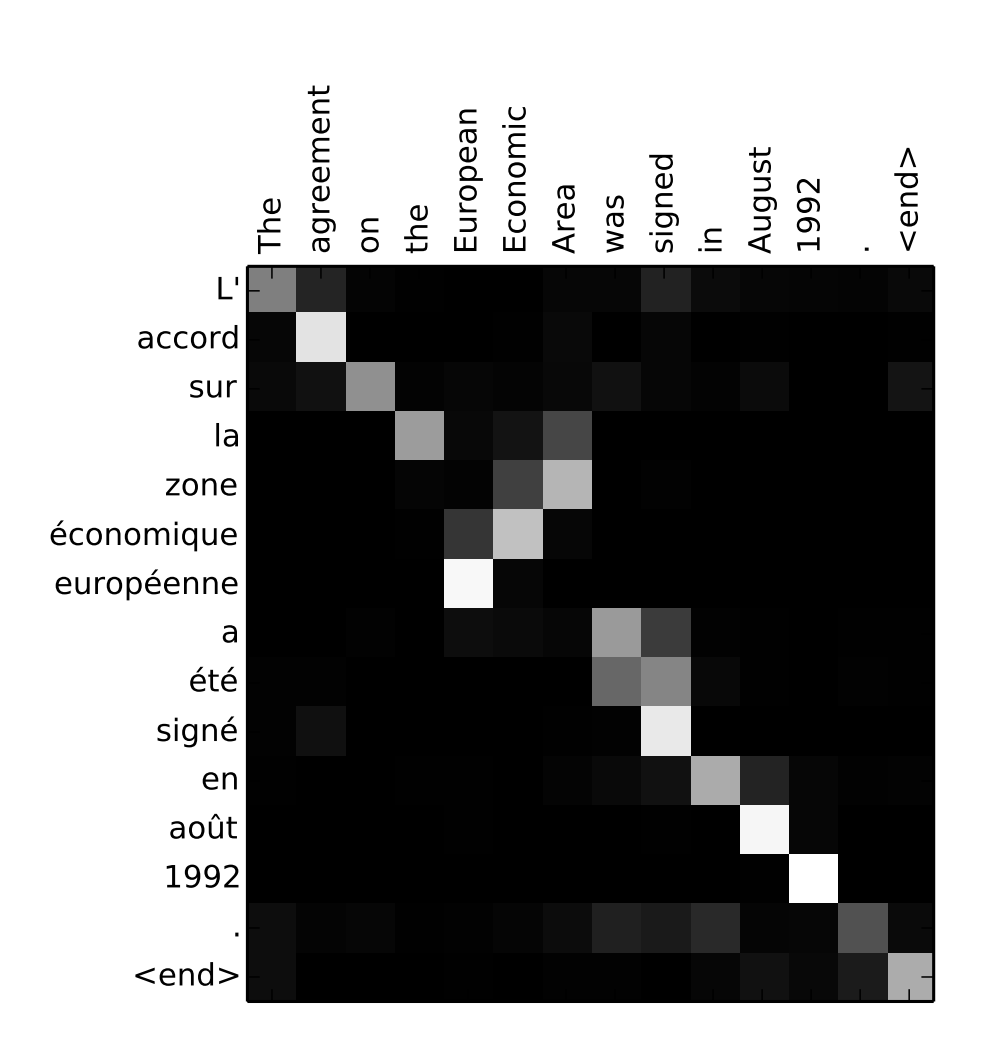
Here each cell corresponds to a particular attention weight . For a trained model and meaningful inputs, we could observe patterns there, such as those reported by Bahdanau et al.: the model learning the order of compound nouns (nouns paired with adjectives) in English and French. Let me end with this illustration of the capabilities of additive attention.
- Jacob Devlin, Ming-Wei Chang, Kenton Lee and Kristina Toutanova (2019). BERT: Pre-training
of deep bidirectional transformers for language understanding. Annual Conference of the North
American Chapter of the Association for Computational Linguistics. ↩︎ - Dzmitry Bahdanau, Kyunghyun Cho and Yoshua Bengio (2015). Neural Machine Translation by Jointly Learning to Align and
Translate. International Conference on Learning Representations. ↩︎